
Žalgiris Group Director Paulius Motiejūnas: “Without the city’s support, we would be talking about Žalgiris’ history, not its future”
Paskelbta: 2026-06-23 (Tuesday)
Over the past decade, Kaunas has transformed beyond recognition—from its revitalized city center and Old Town to the modern Nemunas Island, which has become one of the most important attractions in Lithuania. Alongside the city, Žalgiris has grown as well and today is not only a sports club but also an inseparable part of Kaunas’ identity.
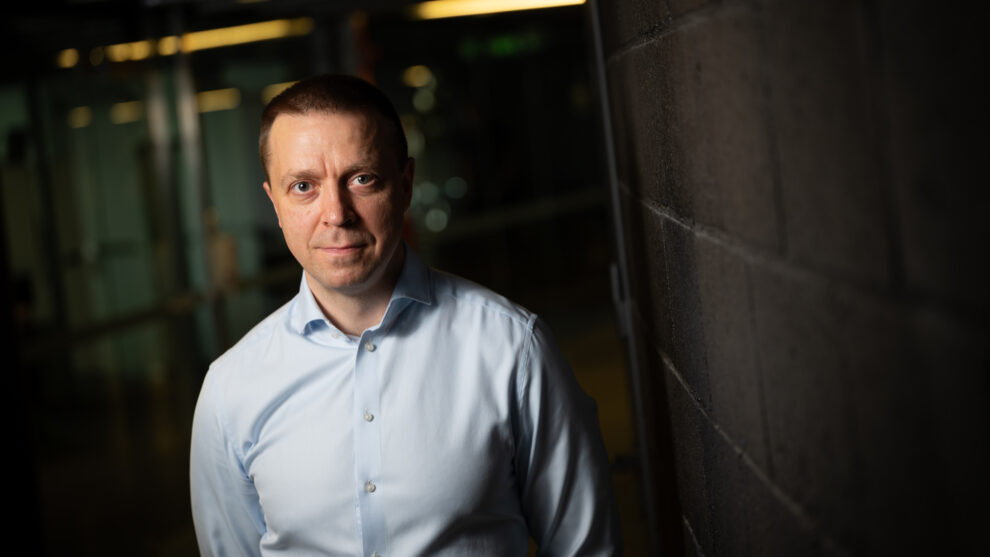
Having served as the CEO of the EuroLeague for nearly three years before returning to Kaunas this year, Paulius Motiejūnas says that living abroad was a valuable experience, but he never had any doubts about where his home was.
The Director of Žalgiris Group shared his thoughts on the growth of Kaunas, the most difficult periods in Žalgiris’ history, the city’s support, leadership, and the dream that keeps him moving forward.
You are a true Kaunas native—born and raised in the city. You spent several years abroad but eventually returned. Does the Kaunas of today surprise you?
Not really. It is wonderful to see Kaunas continue to grow. I have lived in the city center all my life, so I witnessed these changes firsthand. What makes me happy is that the city center has preserved its historical character.
Today, Nemunas Island is home to an arena, a swimming pool, the Science Island museum, sports facilities—there is simply no way not to notice how much Kaunas has changed. That is what brings me the greatest satisfaction.
Whenever I lived abroad, I always missed home. Every time I returned, I had certain places I wanted to visit. Now I am back for good because this is home. When you live abroad, you always feel like you are living somewhere else. And when you see your city and country moving forward, you want to be a part of that journey.
Did returning to Kaunas make you feel nostalgic?
No, because I always knew I would come back one day. I knew everything was temporary. Even while living abroad, I spent my summers in Lithuania. It is hard for me to imagine a better place to spend the summer than Lithuania. Regardless of the weather, it simply feels good to be home, surrounded by your own people and familiar surroundings.
People often say it is impossible to imagine Kaunas without Žalgiris. Do you agree?
Absolutely. I cannot imagine Kaunas without Žalgiris, nor Žalgiris without Kaunas.
I have always said that every city has its flagship symbol. Barcelona, Madrid, and Munich have football clubs around which so much revolves. In Liverpool, there are two defining things—The Beatles and football. For Kaunas, that symbol is Žalgiris.
That is why I never liked the idea that the club belongs to one individual. There were times when we had to deal with the mentality of a former owner who believed, “I’m the owner here; Žalgiris is mine.” I have always felt the opposite—that Žalgiris belongs to everyone, not only to the people of Kaunas. It is Lithuania’s team, although it naturally holds a special place in the hearts of Kaunas residents.
Even today, when I travel abroad frequently, I see many cities with arenas and stadiums, but not everywhere do you feel such a strong connection between a city and its team.
Your career has not been defined only by victories. How do you remember the most difficult periods in Žalgiris’ history?
There were certainly difficult moments, especially during the two major crises the club experienced. But the thought of giving up never crossed my mind.
The year 2015 was about survival. Either the club survived, or there would be no team. We spoke with businesses, the city, and searched for solutions. There were many sleepless nights and a great deal of uncertainty, but when you are in such a situation, you stop counting the cost.
Even then, we never considered the possibility that Žalgiris might cease to exist. Our only focus was on preserving it. This is a club with decades of history, and we understood that we could not allow that story to end.
People who genuinely cared about the team played an essential role at the time. Among them was the current Mayor of Kaunas, Visvaldas Matijošaitis. Even before entering politics, he helped bring people together, develop plans, and generate ideas. There were countless discussions, strategic meetings, and an enormous amount of work aimed at creating a foundation from which we could save the club.
Without the support of both the city authorities and the business community, overcoming that crisis would have been impossible. Without the city’s assistance—not only financial support but support in every sense—we would not have the arena or the entire district that now brings people together and allows us to build further.
Today, we truly feel that we are part of the city. We celebrate successes together, solve problems together, and work toward common goals. We also feel the support of the mayor and his team, and I believe that support will continue.
When speaking about the EuroLeague, you often emphasize tangible achievements—new teams, expansion into the Middle East. What about the less tangible achievements? What did you personally gain from that experience?
Growth.
Those three years abroad were extremely valuable. It was a different culture, a different organization, and a world involving more politics and international processes. It is important to step into different waters, see how others operate, and bring the best ideas back home.
When I took on that role, I felt much the same way I had when I first joined Žalgiris—it was a matter of either succeeding or failing. I am pleased not only that I managed the challenges but also that I gained a deeper understanding of other cultures, especially Spanish culture.
I also worked extensively with partners in the Middle East, building relationships, seeking opportunities, and learning new things.
What makes me happiest is not merely the concrete results but the fact that I grew as a person. Growth is never easy. It comes with mistakes and setbacks, but the most important thing is to keep moving forward. If you truly believe in what you are doing, it is always easier to get up and continue.
We all make mistakes. That is why I deeply appreciate people who allow others to make mistakes while helping them get back on their feet and learn from the experience. That is how growth happens.
Are you satisfied with where Žalgiris stands today?
Very much so.
One of the greatest rewards is seeing that after you step away, everything does not collapse but instead continues moving forward even more strongly. That means you have built a good team—one that is motivated and understands the ultimate goal.
Today we are seeing some of the best sporting results in recent years, we have the largest budget in the club’s history, and we continue to grow steadily. That is very encouraging.
What does leadership mean to you?
For me, leadership is first and foremost the ability to help others grow, inspire them, and motivate them to achieve more.
I often say that I look for a person’s “superpower”—the area in which they can become the very best. That applies equally to players and administrative staff.
The greatest satisfaction comes from seeing someone arrive with passion and ambition, helping them unlock their potential, supporting their development, and then watching them take off. To me, that is true leadership, and it is something we continue learning every day.
Do you get angry when people make mistakes?
No. I enjoy developing people and helping them become “our own,” as we say.
Of course, managing a sports organization like Žalgiris is challenging. You cannot simply recruit experienced professionals from anywhere at any time. That is why I value young people, their growth, and their willingness to learn.
In this respect, Kaunas has a major advantage as a university city. We cooperate with universities, run various programs, and contribute to the education of future professionals.
Discipline at work is important, but fear is not. What should motivate people is the desire to improve and perform better. There has to be a common goal that unites everyone.
Take Šarūnas Jasikevičius, for example. Many people see him as very demanding, but everything he does is motivated by the desire to make the team and its players better. Not everyone may appreciate that style, but the goal is always shared.
Do you have a favorite basketball team other than Žalgiris?
No. There can only be one true love.
If we talk about the club’s greatest achievements, is a sold-out arena among the most important?
I believe so.
When you remember a time when there was a real possibility that all of this could disappear and then look at where we are today, you realize how many people contributed to this success.
What I am most proud of today is what the club itself has become. Žalgiris is a successful, beloved, and necessary organization that has preserved its Lithuanian identity.
The city has played a major role in that transformation. Stability and support emerged. We never take that for granted. We feel that the city genuinely cares about us and that we are all moving toward the same goal.
Has the mentality of the fans changed?
Very much so.
The entire culture of support has evolved. There are more people, greater engagement, and stronger involvement.
Most importantly, however, you can still see three generations sitting together in the stands—a grandfather, a father, and a grandson. That continuity and love remain unchanged.
The form may change, but the essence stays the same. Today, fans are more focused on lifting the team up rather than criticizing it. The pressure remains, but it is healthy and motivating.
Sometimes the players themselves ask for one more sold-out game because they want to experience that atmosphere again.
How important is it for a city to invest in sports?
It is difficult for me to be completely objective because I have a vested interest, but in my opinion, it is extremely important.
There are two sides to it. Sport helps create a city’s identity and attracts tourists and fans. The benefits return to the city not only economically but also through international visibility and reputation.
Most importantly, however, there must be partnership. Partnership with the city is the only path to success.
Without the city’s support, very little can be achieved. We are simply too small to compete alone. We are competing against cities such as Madrid, Milan, and Athens. Because the city contributes financially and through infrastructure, we gain advantages that help level the playing field.
Without that support, we would not have the arena, we would not have hosted the EuroLeague Final Four, and everything would look very different. We would be a historical symbol, talking about Žalgiris’ past rather than its future.
Instead, we can dream boldly and pursue ambitious goals.
Looking back on the journey, what are you most proud of today?
Sometimes we do not fully appreciate what we have accomplished.
What we have today is enormously valuable to me. A full arena, 40 sold-out games, constant fan support—none of this happened by accident. It represents an immense amount of hard work.
I suspect it will be difficult to replicate over the next five years because bringing elite European club basketball to Lithuania is no easy task.
At the same time, I am especially proud of the EuroLeague Final Four held in Kaunas, an achievement that perhaps has not received the recognition it deserves.
At the time, we may not have fully understood its significance. Today, however, I frequently meet people abroad who say, “I was in Kaunas for the Final Four.”
When you hear Kaunas mentioned alongside cities such as Athens and Abu Dhabi, you realize the impact such an event has on a city’s reputation.
If you could turn back time, would you change anything?
No.
That is simply how growth works. There is no universal recipe for life. You make mistakes, correct them, learn, and move forward. That is the natural sequence of things.
If we knew all the answers or could constantly rewind time, we would probably never move forward at all.
What kind of Kaunas would you like to see in the future?
Kaunas today is a completely different city from what it was ten or fifteen years ago.
Back then, many people did not believe an arena would ever be built on Nemunas Island. Today, it is one of the city’s defining symbols.
I would like to see the city continue growing while preserving its character—the Kaunas mentality of ambition, courage to dream, and belief that more can always be achieved.
I hope modernization and growth continue hand in hand with the identity that makes Kaunas unique.
And from a sporting perspective, the conditions currently available to athletes in Kaunas are simply incredible. All that remains is to make the most of them.
What is your biggest dream related to Žalgiris?
To win the EuroLeague.
Without question.
I vividly remember the emotions when we finished third in the EuroLeague. The number of fans who gathered in Town Hall Square and the atmosphere throughout the city were unforgettable.
If we were to win the EuroLeague one day, I imagine the entire city would explode with joy.
What would you wish for Kaunas?
Never stop.
Growth should never stop. We cannot think that we are already good enough because we can always become better.
I would wish for the people of Kaunas never to forget who we are—ambitious, determined, striving for high goals, and unafraid to dream.
At the same time, we should appreciate what we already have. When you travel and see the world, you realize that we truly have everything here.
That is something I have always been proud of.
For me, Kaunas has always been—and remains—a true symbol of freedom.


Contacts
Kaunas City Municipal administration,
Municipal budgetary institution,
Laisvės al. 96, LT-44251 Kaunas
Data is kept and stored at Registry of Legal Entities
Code 188764867
VAT payer‘s code LT 887648610
2017 m. Kaunas City Municipal. It is forbidden to copy and distribute the information available at www.en.kaunas.lt without permission of the authors.